In January 1945, a new armoured vehicle was issued to the anti-tank
regiments of the infantry divisions in 2nd Canadian Corps. There were
two of these regiments: the 2nd and 3rd, in 2nd and 3rd Canadian
Infantry Divisions respectively. The new vehicle was known to the army
as the “17-pounder Valentine SP”, SP meaning self-propelled, but the
British Ministry of Supply named it the “Archer”, and that is how it is
commonly known today.
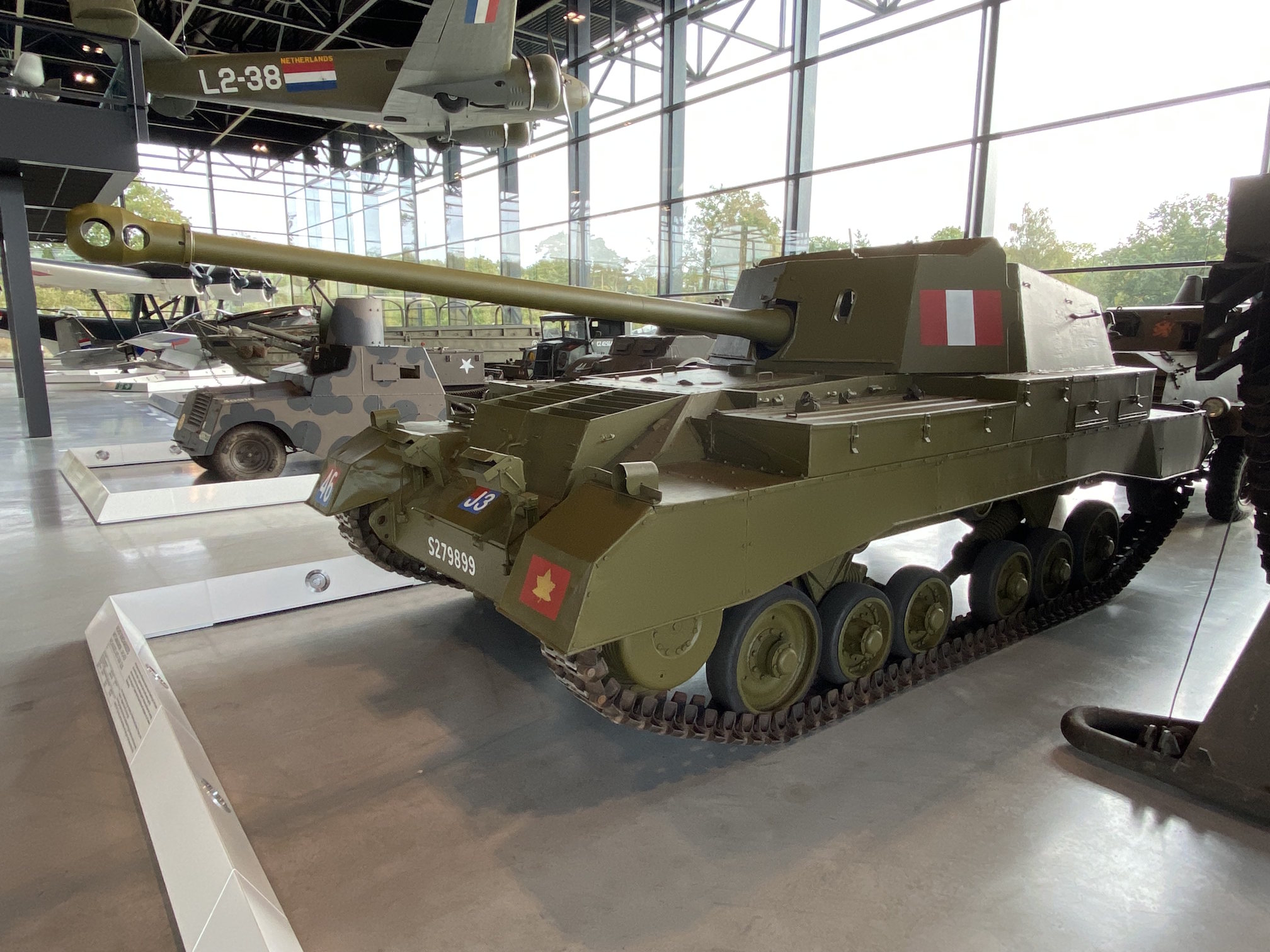
An Archer in the National
Military Museum of the Netherlands.
The Archer does not have a strong presence in Canadian memory of the
Second World War. In Northwest Europe, it only served for four months,
and there are no examples in any of our museums. C. P. Stacey was
generally vague about anti-tank equipment in The Victory Campaign, and
in a recent article in Legion Magazine, the authors misidentified
Archers in Groningen as M-10s.
To the Archer’s harshest critics, it was “quite useless”, but the
Archer was a good solution to a serious problem for the anti-tank
artillery. It greatly improved the effectiveness and flexibility of the
gunners equipped with it. In the Rhineland campaign and the liberation
of the Netherlands, the Archer went side-by-side with Canadian
infantry.
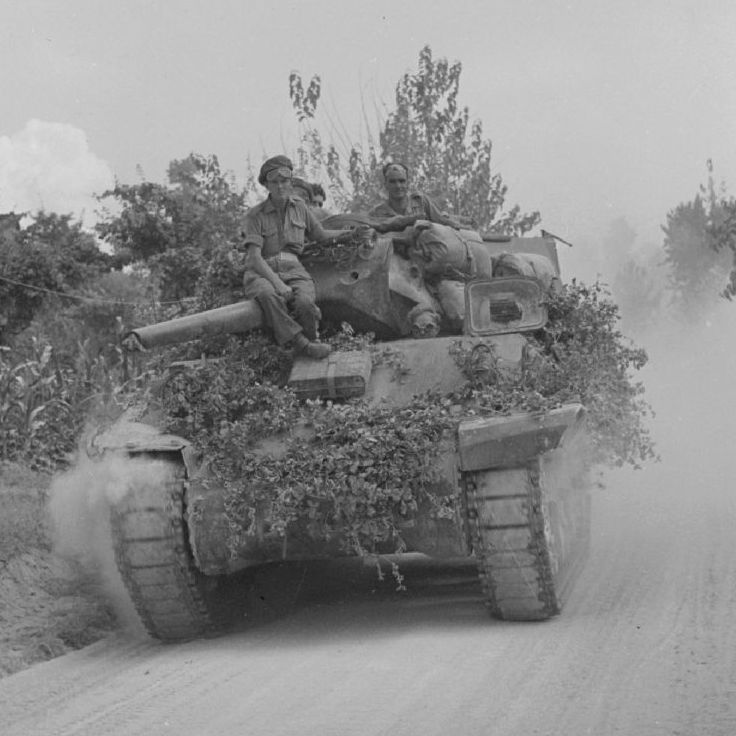
A Canadian M10 in Italy equipped with the 3" gun.
(Source: Library and Archives Canada, Item ID 3607960)
Back in 1942, the British General Staff had decided that they wanted
self-propelled anti-tank guns that could keep up with tanks. They
ordered M-10s from the USA, but in case not enough were available, they
also put out a tender for a vehicle to be made in the UK. This needed to
mount the 17-pounder gun, and have a low profile to make it easy to
conceal. This was based on the British experience in the desert, in
which anti-tank gun crews found themselves at the receiving end of every
type of German attack possible once they were spotted. Vickers-Armstrong
submitted the design of the Archer, based on the components of the old
Valentine tank. To obtain a low profile, they mounted the gun backwards
on the small chassis. By the time production began in April 1944,
Britain was beginning to convert M-10s to mount the 17-pounder. The
Archer was declared obsolescent, and there was no immediate plan to put
it into service. It appeared to be little more than a make-work
programme.
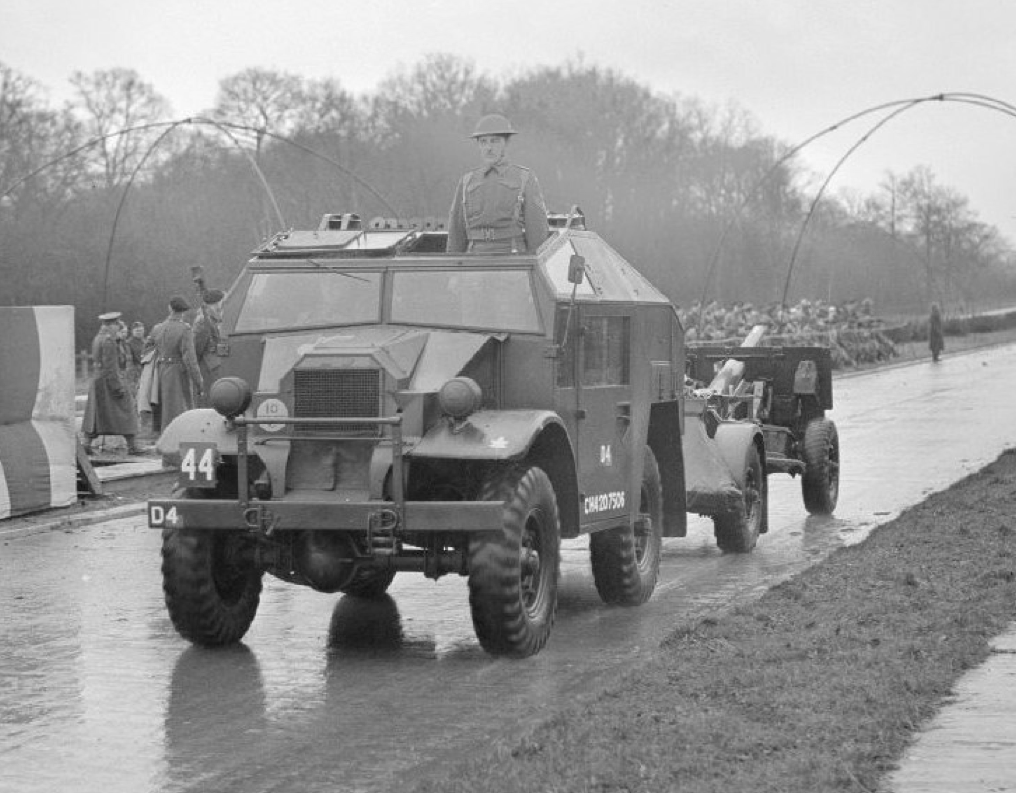
A field artillery tractor pulling
a 25-pounder gun (Source: LAC, Item ID 3604368)
However, two Archers were sent to Normandy in July so that officers
of 21st Army Group could inspect them. By that point, British and
Canadian anti-tank regiments had become very unhappy with the towed
17-pounder gun. It was very large, and the standard Field Artillery
Tractor had great difficulty moving it off-road. This forced the men to
move it into position by hand, before also digging it in. This was
difficult, time-consuming work, during which the men were more
vulnerable to enemy fire.
So, the officers who saw the Archers greatly approved of the design.
They felt that any self-propelled 17-pounder would be an improvement,
and the Archer’s limited field of fire to the rear was not a serious
problem. Artillery purists were reassured that the Archer looked like a
gun, and not a tank.
The British and Canadian armies discussed the issue in August 1944
and decided to equip the anti-tank regiments in their infantry divisions
with the Archer. However, due to the tempo of the campaign and a lower
shipping priority for the Archer, adoption did not begin until November.
The two Canadian regiments received 12 Archers each in January 1945.
3rd Anti-Tank Regiment had been equipped with 16 M-10s from D-Day until
this point. According to the regiment’s war diary, the men “felt the
loss of their M 10s, but [were] very rapidly acquiring a healthy respect
for the Valentines.”
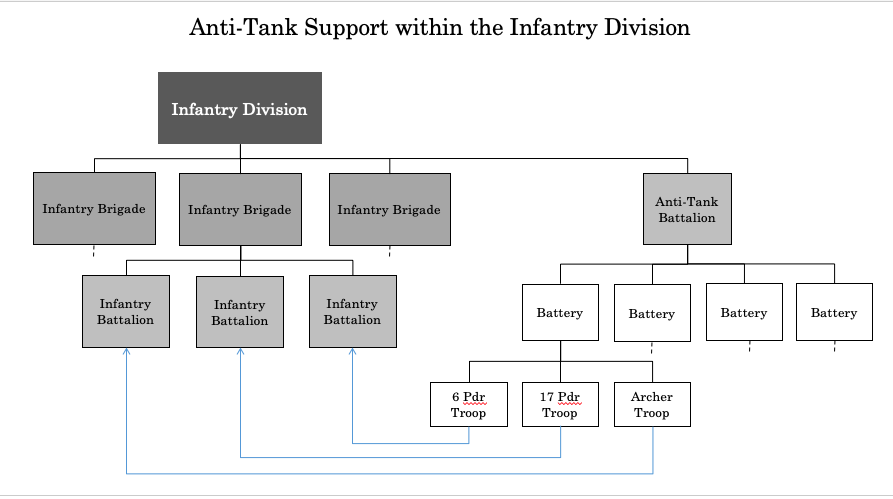
Each troop is assigned to support a different battalion of infantry.
These anti-tank regiments were made up of four batteries, in each of
which were three troops. One troop in each battery was now equipped with
three Archers. During operations one battery would be placed under the
command of each brigade in the division, with one troop supporting each
battalion. The fourth battery would remain in reserve.
By now, however, the attacks and counter-attacks of the desert war
were long over. There were not many instances in which the Archer was
actually used in its intended anti-tank role.
On the 8th of February, First Canadian Army launched Operation
Veritable as part of a pincer movement to capture the area west of the
Rhine which faced 21st Army Group. During Veritable, the largest
anti-tank engagement in the war which involved Archers took place. This
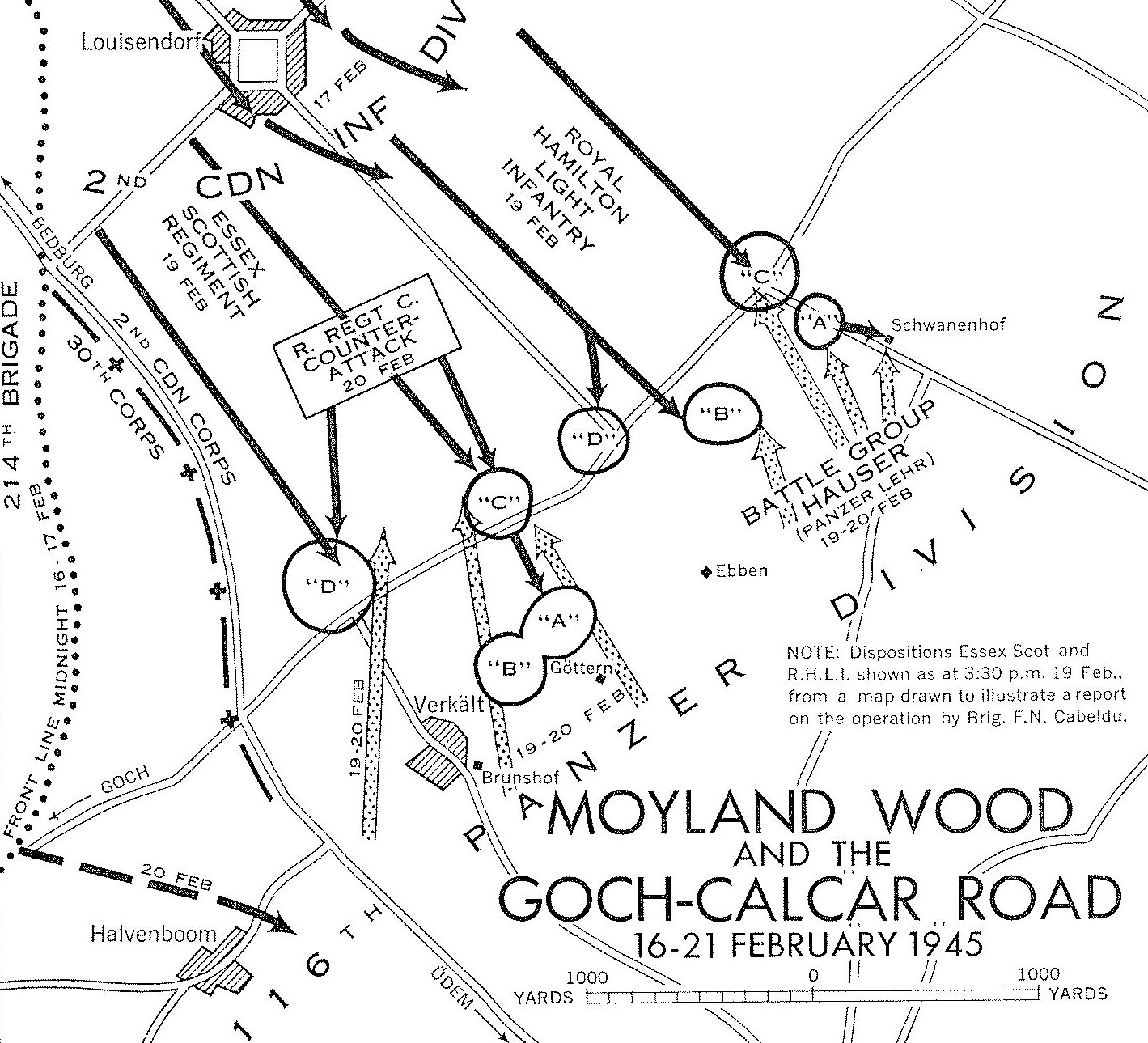
was the battle for the Goch-Calcar Road, which was fought to establish
the start line for the follow-up Operation Blockbuster.
Source: The Victory Campaign by C P Stacey
On the 19th of February, 2nd Canadian Infantry Division launched a
set-piece attack with 4 Brigade to seize positions along the road, with
massive artillery support, tanks, and Kangaroos. The Royal Hamilton
Light Infantry were on the left, and the Essex Scottish on the right.
The ‘Rileys’ soon took their objectives, but the Essex Scottish had a
more difficult time, and the Germans began to counter-attack both
regiments. Following standard armoured doctrine, at dusk the Shermans
withdrew, but a troop of Archers joined the ‘Rileys’. Overnight,
elements of the Panzer Lehr division made multiple attacks against both
regiments. The Rileys were barely able to hold their ground after
calling up the men left out of battle, while the Essex Scottish were
overrun by German tanks and infantry. Pockets of the regiment continued
to hold out, but could not prevent the Germans from moving through the
area to attack the Rileys.
On the 20th, the Germans made several attacks on the Rileys supported
by Panthers and Jagdpanthers, but were ultimately unsuccessful. In one
of these attacks, three German AFVs were knocked out by a single Archer.
Major Louis Froggett said of this,
“If those tanks had gotten through D Company, they would have hit
Battalion Headquarters and rolled up the battalion. They were stopped
right in front of the milk factory [where the headquarters was located],
less than a hundred yards away.”
During the day, the Royal Regiment of Canada and supporting forces
fought for and retook the positions of the Essex Scottish. Panzer Lehr
made one more unsuccessful attack that evening, and then withdrew.
Altogether, the Germans lost seventeen tanks and Jagdpanthers in the
battle, and the Archers accounted for seven of these.
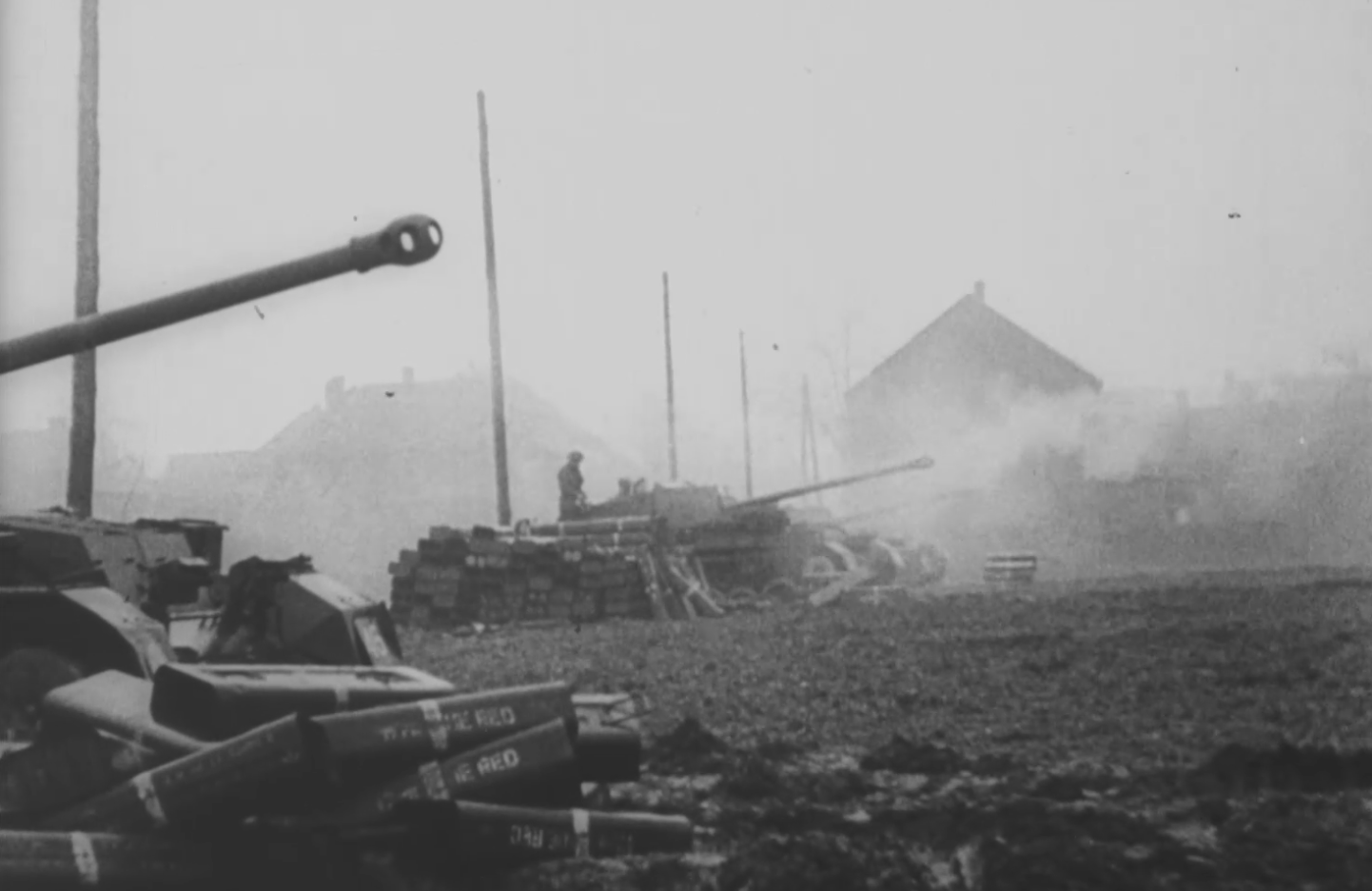
Some British Archers participating in a bombardment targeting
or near the city of Goch. (Source: US National Archives, newsreel NAID:
39158)
In addition to defending against German attacks, the Archer
participated in the so-called “pepperpot” element of artillery
bombardments, in which guns of all sizes fired on the enemy. Archers
came supplied with the gear needed to aim and fire indirectly, which
some towed 17-pounders were also receiving. After the men received
training in indirect fire, the Archers of both regiments contributed to
the huge bombardments that began Operations Veritable and Blockbuster,
as well as other, smaller barrages.
They were also called upon to knock out observation posts in strongly
constructed buildings. The point of this, of course, was to prevent the
Germans from being able to see Allied troop movements and direct their
artillery fire. The 17-pounder gun was better at this than the field
artillery, because of its accuracy and its ability to deliver a mixture
of armour piercing and high explosive rounds. For instance, towards the
end of Blockbuster, an Archer put 13 rounds into a windmill in Xanten
the day before 2nd Division launched its attack to take the town. Towed
guns were also used against observation posts, but the gunners knew that
German artillery would quickly return fire on them. The Archer’s ability
to start up and leave immediately made it a safer to use for the job.
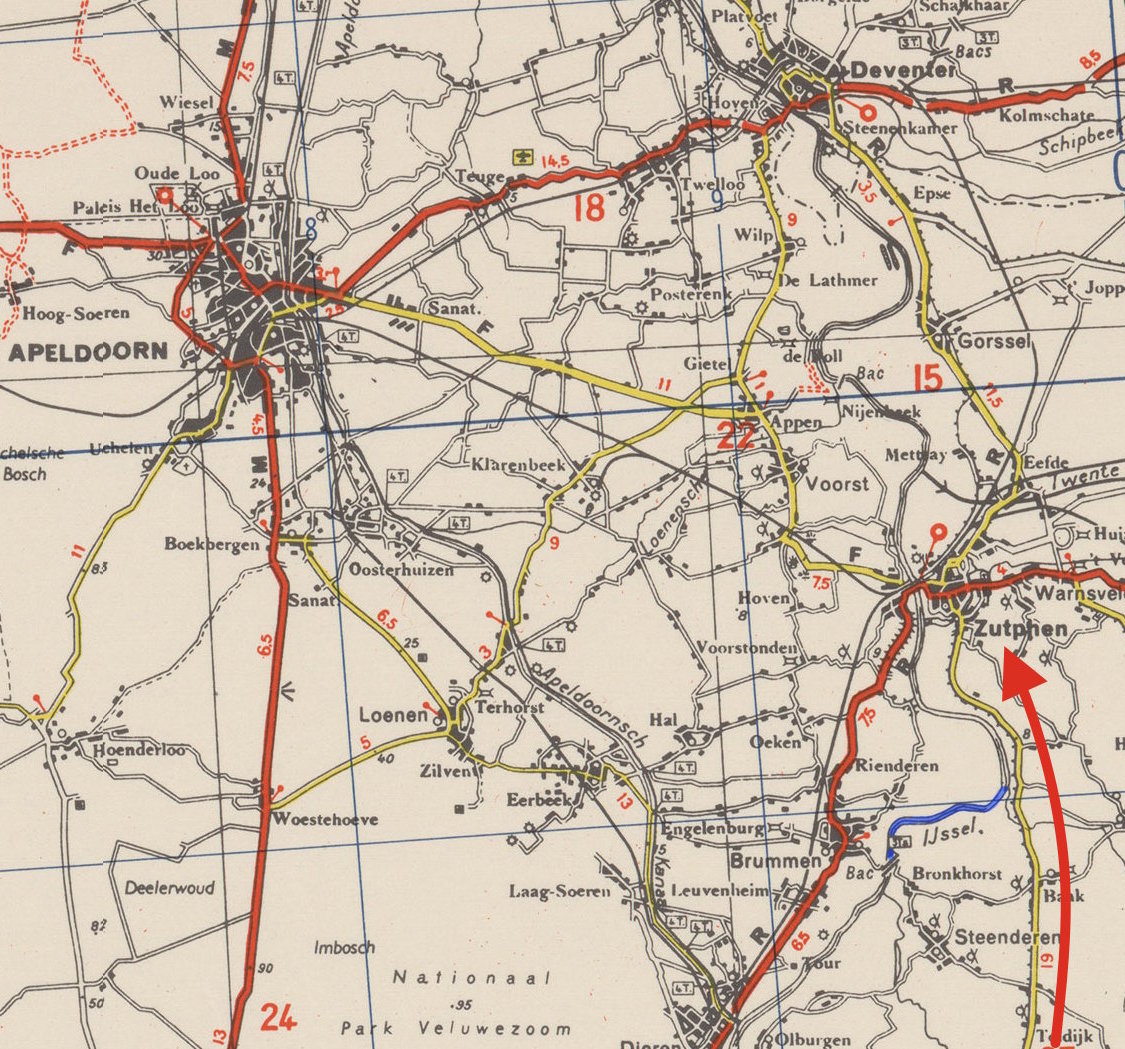
The route of 3rd Division is shown in red. The area along
the river marked in blue was guarded by 3rd Anti-Tank Regiment.
Later, when 2nd Canadian Corps advanced into the Netherlands, Archers
were put to a variety of duties on the flanks. From 6th to 13th April,
one battery of 3rd Anti-Tank Regiment guarded a five-kilometer stretch
of the IJssel river on the left flank of 3rd Division. Some of the
gunners took on the role of infantry, while the Archers acted as
armoured support. The Archers harassed German positions on the far side
of the river, and successfully counter-attacked patrols which crossed
the river at night and attempted to infiltrate into the settlement of
Bronkhorst.
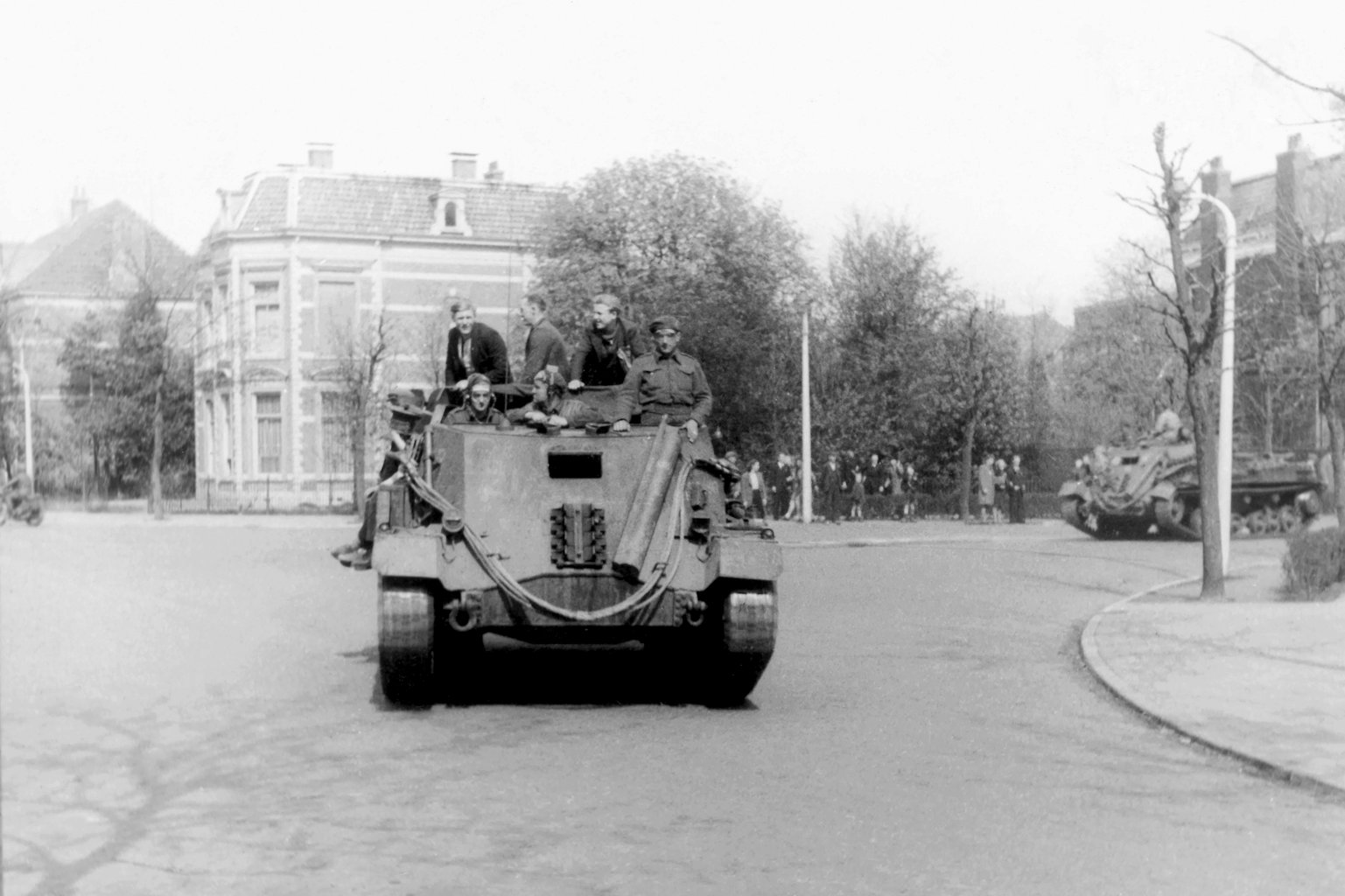
Civilians catch a ride on an Archer of 108th Battery
driving through Meppel (Source: Oud Meppel photo archive)
Further north on the evening of 12th April, 108th Battery joined
Toronto Scottish machine gunners to protect the left flank of 2nd
Division as it drove towards Groningen. This wide-ranging ‘defence’ led
to two platoons of carriers and a troop of Archers entering the town of
Meppel the next morning - so far west that it was actually on 3rd
Division’s route north. The Germans had only just left, and the Dutch
gave the Canadians a heroes’ welcome. After driving through the town,
the Archers guarded the bridges while the Toronto Scottish captured
German stragglers.
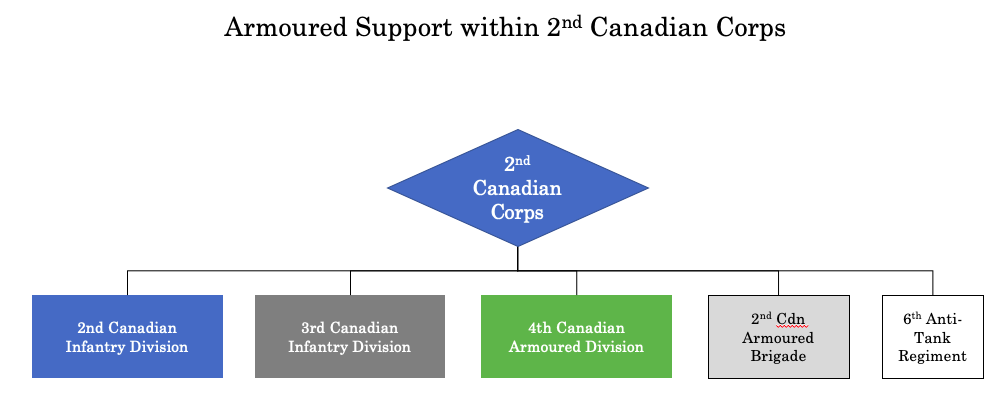
But, after the crossing of the Rhine the Archers spent most of their
time providing close support to the infantry. Within the corps, the
force responsible for infantry support was 2 Armoured Brigade, which had
135 Shermans available, excluding headquarters tanks. The Corps also had
6th Anti-Tank Regiment with two batteries of M10s which sometimes
supported the infantry, but in this period, they had other tasks to
perform.
135 tanks were by no means enough to provide constant, universal
support to two infantry divisions. 2nd and 3rd Anti-Tank Regiments now
had 30 Archers between them. There were plenty of opportunities for them
to assist when Shermans were not available.
Source: The Victory Campaign by C P Stacey
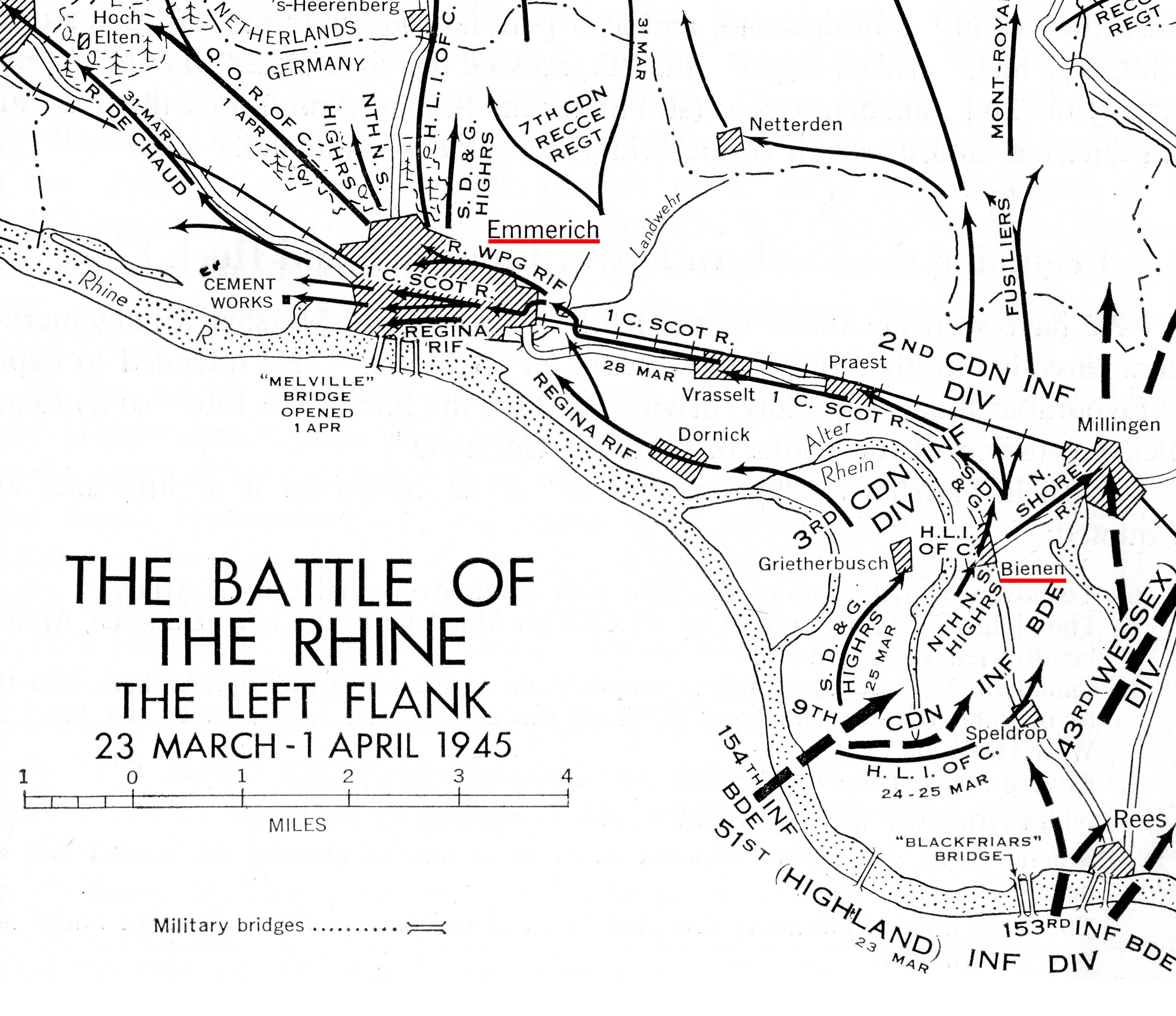
The Rhine crossing began during the night of 23th March. 9 Canadian
Infantry Brigade crossed on the morning of the 24th, and that evening a
troop of Archers from 3rd Anti-Tank Regiment were among the first AFVs
to be ferried over. Possibly the bitterest fighting of the landings had
been taking place in the villages of Speldrop and Bienen. The troop
moved towards Bienen with the North Nova Scotia Highlanders the next
day. Then, sometime after midnight a German self-propelled gun had
knocked out a supporting British tank and was suppressing two platoons
of the North Novas. The troop of Archers, commanded by Lieutenant
Anderson was called up. Sergeant Comeau followed the sound of the German
AFV in the dark, and to confirm its position they fired a machine-gun at
it. When the Germans returned fire with their own machine gun, the
tracer bullets revealed their position. One of the Archers promptly
fired, knocking it out.
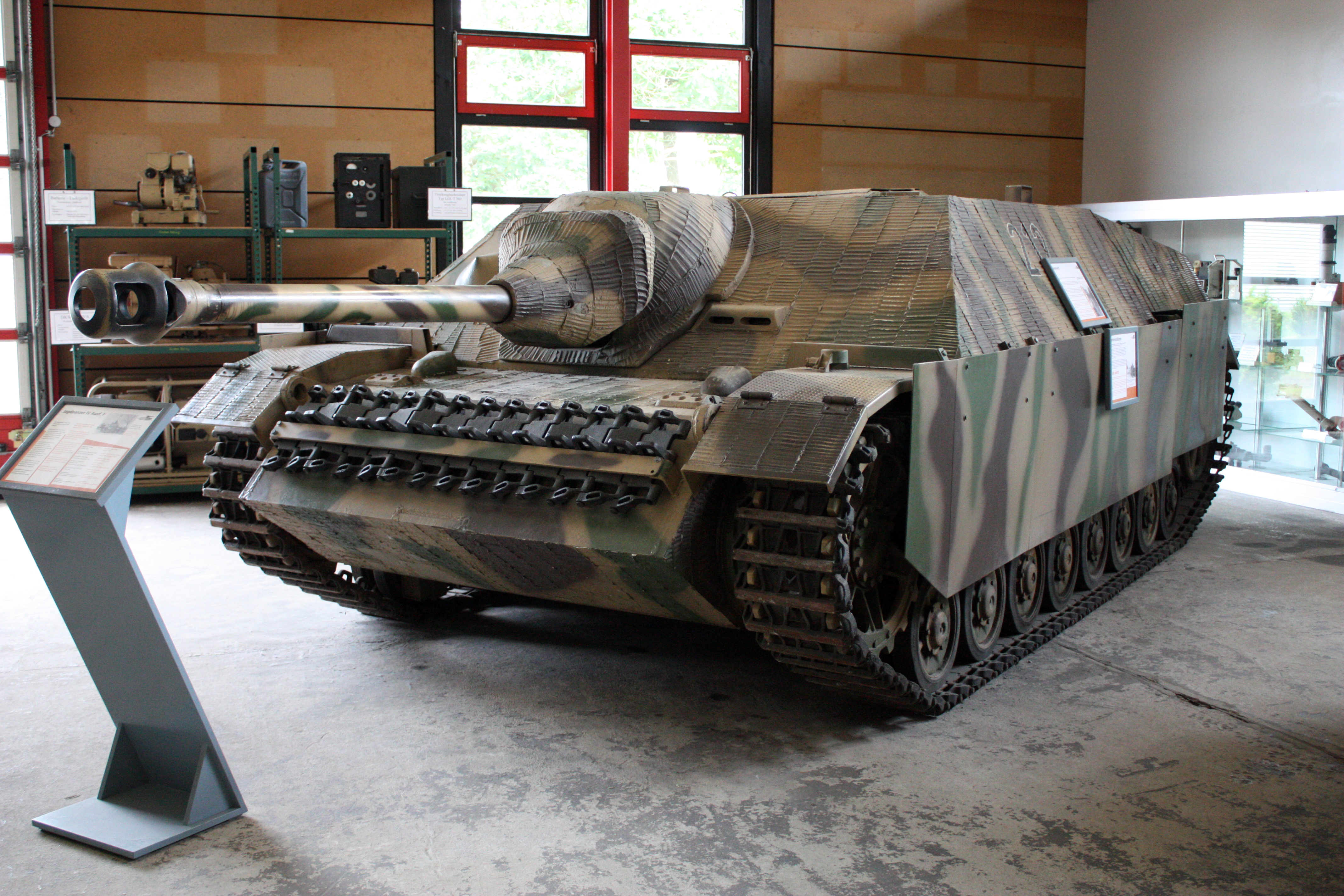
The commmon self-propelled gun encountered
at this stage was the Jagdpanzer IV. Image made available under the
CC BY-SA
License
The following morning, Lieutenant Anderson and a major of the
Highlight Light Infantry of Canada spotted another German self-propelled
gun down the road to Millingen, along which the North Shore Regiment
would soon advance. Anderson ran back for his Archer, and they set it on
fire with the first shot.
On the 30th March in the city of Emmerich, the Germans
counter-attacked the Royal Winnipeg Rifles from the north. One of their
self-propelled guns pinned down a company of the Winnipegs. Sergeant
Darrow Gomez, commanding an Archer, was asked to deal with it. After a
reconnaissance under small arms fire, he flanked the German AFV with his
Archer and knocked it out. Gomez then went on another reconnaissance
with Major Denison of the Winnipegs. Eventually they located another
German self-propelled gun which had been firing on the infantry, but the
Major was killed right next to the Sergeant. Probably after Gomez
returned to his Archer, it was hit twice by shellfire and the driver
severely injured. The Sergeant and his two remaining men positioned the
Archer and then waited until artillery and an air-to-ground attack by a
Typhoon distracted the Germans. They then drove into the open, turned,
and disabled it with one shot.
Archers continued to support the infantry through the Netherlands and
into Germany. They fired – along with tanks and field artillery – at
some targets on the causeway linking Friesland with North Holland.
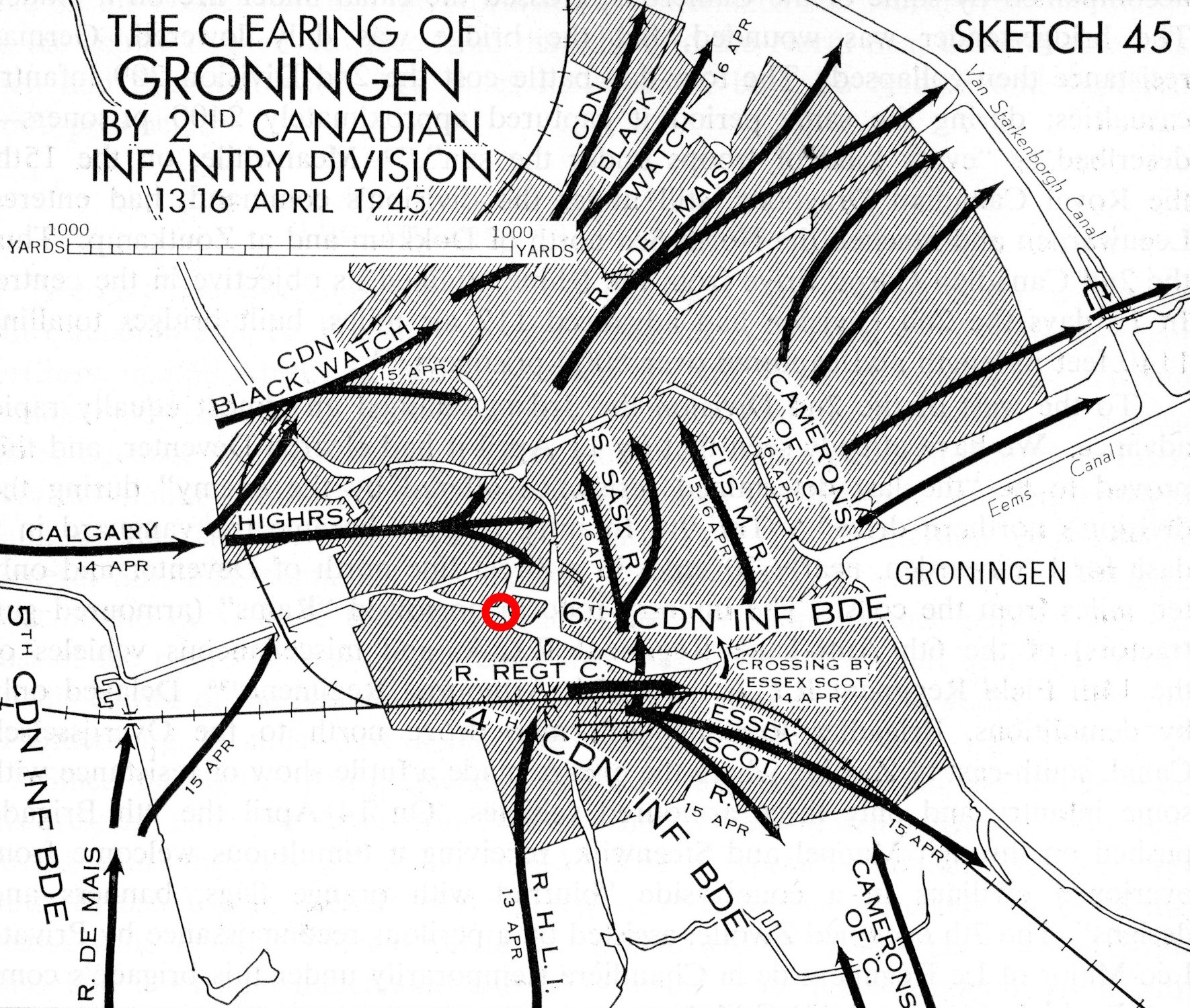
During the battle for Groningen, German snipers, machine guns and flak
guns completely pinned down c Company of the Royal Hamilton Light
Infantry near the one of the bridges. No tank support was available, but
an Archer from the troop that had supported the Rileys at the
Goch-Calcar Road came to their rescue, knocking out enemy positions in
the upper stories despite fire from the upper stories at their
open-topped vehicle.
Source: The Victory Campaign by C P Stacey
The success of the Archer was affected by several underlying
conditions. First and foremost, Allied air superiority enabled the
Archer to move about more freely. The Archer’s thin armour and open top
would have made it vulnerable to enemy air attack. Secondly, the
weakness of the German armoured force created the opportunity for the
Archer to be used in other roles. Had German forces been stronger in
these regards, the Archer would have had to been used much more
conservatively.
Overall, the Archers in the two regiments knocked out a dozen German
AFVs. Only three Archers were lost to enemy weapons – one to mines and
two to shelling. The fact that none were knocked out by towed anti-tank
guns or infantry weapons is remarkable, and speaks to their careful
deployment.
Medal citations from the battle at the Goch-Calcar Road consistently
mention the gunners moving their Archers to new firing locations after
the Panthers were spotted. This was clearly important. It probably
involved positioning the Archers where they could shoot at the tanks
from the flank, which reduced the chance of them being spotted, and gave
them the opportunity to fire at weaker side armour.
Moving also reduced the gunners’ casualties so that they could
continue the fight. The crew of a towed gun under fire had to choose
between fighting, or abandoning the gun to take shelter. Veteran Les
Goff was one of the men who crewed the Archer which knocked out the
three AFVs that threatened the Rileys’ headquarters. He remembered that
immediately after they fired those shots, German artillery began to zero
in on them. Their Sergeant suffered a minor injury from shrapnel. The
driver then moved the Archer safely behind a building.
By destroying so many AFVs in the battle, these Archers played a
vital role in the defense. Had the troop been equipped with towed guns,
it seems doubtful they would have done so well. The Royal Hamilton Light
Infantry lost 125 men in the battle, and the Essex Scottish 204. Had
their anti-tank defence failed, the Rileys might have suffered just as
badly as the Essex Scottish.
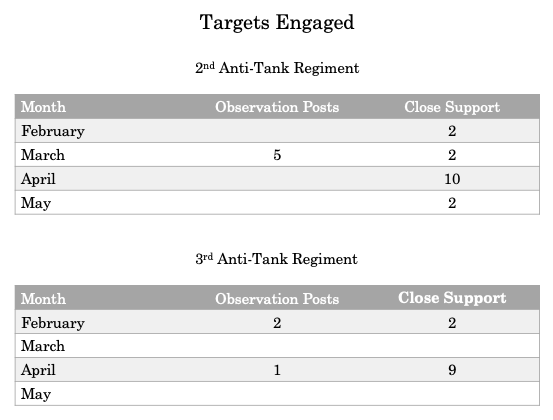
Firing on observation posts and close support targets also reduced
infantry casualties. The most frequent of these targets were buildings
containing infantry with small arms, a machine gun post, or sometimes a
sniper.
The Archer troops were busy at this throughout April. An extreme case
was that of 20 Battery, which on the 29th of April reported that the men
of the Archer troop were getting very tired. This battery was under the
command of 5 Brigade in 2nd Division. Rather than supporting one
infantry battalion and resting when that battalion rested, these Archers
were being switched from one battalion to another – nine times in April
– so they could support as many attacks as possible. If the towed guns
had all been replaced with Archers, this would have been unnecessary,
but the rate of production of Archers in the UK was not fast enough to
make that possible. It also does not appear that the commanders of the
other brigades were pushing their Archers so hard, but the inconsistent
level of detail in the war diaries does not let me state this with
certainty.
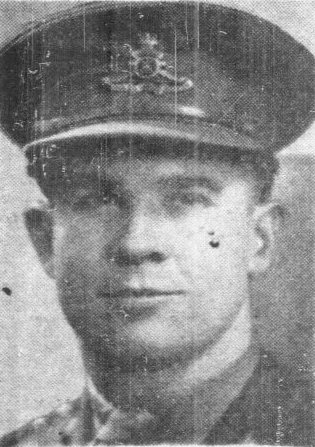
Acting Lt-Colonel McMullen. He had been 2IC before taking on the role of
commanding officer in late 1944. (Source: The Toronto Star)
The war diary of 3rd Anti-Tank Regiment provides some valuable
insight into how the Archer was viewed at the time. The commanding
officer, Lt-Colonel William McMullen, added a page of commentary to the
war diary every month. In March, he wrote that “one lesson was well
learnt by the Regiment. That is, that [self-propelled] anti-tank
equipment is far superior to towed anti-tank guns at any role.” Since
his regiment had used the M-10 for much longer than the Archer, it seems
clear - that to him, the mobility of a self-propelled gun was far and
away its most important quality.
In April the regiment’s second-in-command, Major Boothe, wrote that
the Archers had been used to provide close support to the infantry with
no losses, but since the Archer could only fire from the rear, he did
not consider it a practical close support weapon. This was also the
general consensus of the regiments in 21st Army Group.
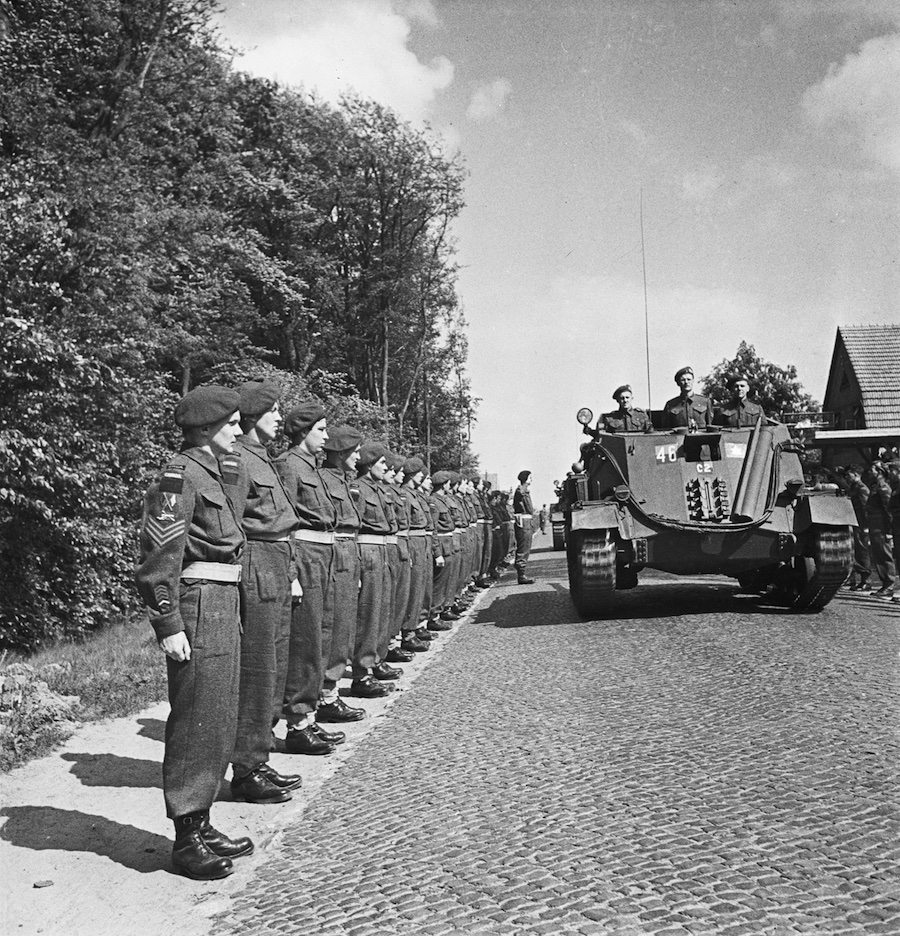
Parade of 2nd Division Guns, 15 May 1945 (LAC PA-197935)
Despite not being ideal, however, the Archer had succeeded in this
role. A history of the 3rd attributed their success to “the high level
of marksmanship on the part of the gun crews. Time and time again, enemy
[self-propelled guns] and strong points were knocked out by the first
round fired.” High praise, but in the battles described earlier, the
gunners of these two regiments demonstrated not only marksmanship, but
also bravery, cleverness, and determination.
In 1945, Allied victory was certain, but soldiers had to carry on the
offensive day after day to achieve it. Canadian anti-tank gunners had
given a defensive role which was of decreasing importance. Equipped with
the Archer, however, they could not only defend but also knock out
observation posts, protect the flanks, and provide close support to the
infantry. Although not many in number, they certainly contributed their
share to the defeat of Nazi Germany. They, and the equipment they used,
deserve to be better remembered.
This paper was presented at the 36th Canadian Military History Colloquiem at
Wilfred Laurier University in 2026.